

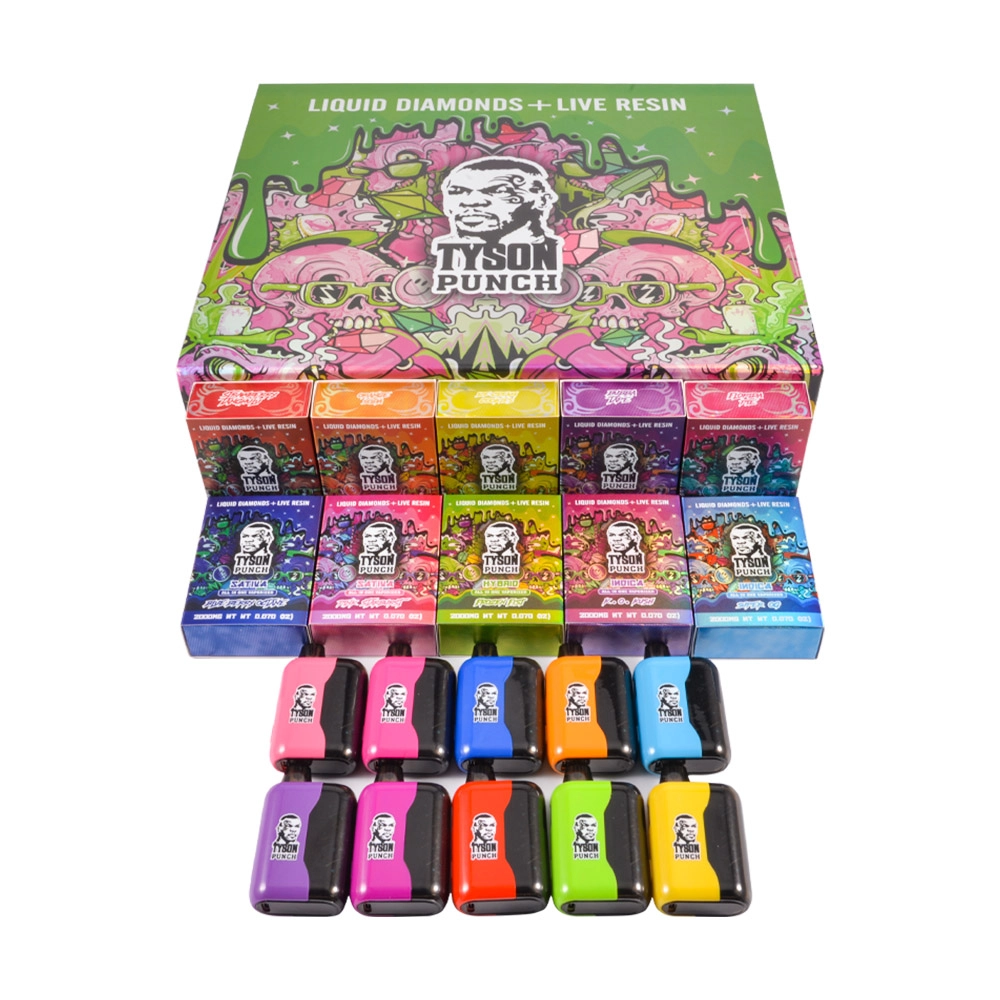
Important: This article discusses empty vape hardware only (no oil, no nicotine, no THC/CBD included). Always follow your local laws and use a licensed, compliant supply chain for filling and distribution.
Tyson Punch 2g With Screen: Why It Sells (A B2B Hardware-Only Breakdown)
“Screen disposables” don’t sell because they look cool. They sell because they reduce uncertainty at the exact moments that create returns, bad reviews, and support tickets: battery anxiety, inconsistent performance, and unclear device status. Combine that with the economics of 2g formats and a dual-flavor-ready platform, and you get a SKU that moves fast when you stock it correctly.
TL;DR: A screen increases buyer confidence, 2g improves perceived value, USB-C matches modern charging expectations, and a dual-reservoir design helps brands run flavor pairs and SKU strategies with fewer operational headaches.
What the Tyson Punch 2g With Screen is (on Extractsvape)
The Tyson Punch 2g disposable vape with screen is positioned as a hardware-only platform built for fillers and OEM partners. The published spec highlights a dual-flavor-ready structure (two independent 1g reservoirs) with a manual left/right toggle, plus USB-C recharge and a ceramic heating core for more consistent heating behavior once filled under compliant conditions.
Why that combination matters in wholesale
- Dual-reservoir + toggle supports “two-in-one” flavor concepts without doubling shelf space.
- USB-C recharge reduces “dead-on-arrival” complaints tied to battery depletion during storage/transit.
- Screen visibility lowers buyer uncertainty and speeds retail decision-making.
- Ceramic core is often chosen for cleaner flavor transfer and more stable heating when paired correctly with oil viscosity and fill process.
7 reasons it sells (and keeps selling)
1) The screen solves the #1 retail friction: “Is it charged? Is it working?”
A visible status display turns invisible device states into obvious signals. In real retail terms, that means fewer “it doesn’t hit” counter conversations that are actually low-battery or mode confusion. For distributors, fewer returns and fewer support tickets is a direct margin lift.
2) Premium cueing: a screen makes the device feel like consumer electronics, not a throwaway
Buyers already expect electronics to communicate battery and state. Screen devices borrow that expectation and convert it into perceived value—especially at the display case where differentiation is visual.
3) USB-C is now the default expectation
Across consumer electronics, USB-C has become the common baseline (and is reinforced by the EU’s “common charger” rules for many device categories). Even when a product category isn’t explicitly covered, the market expectation has shifted: customers want the cable they already own to work.
4) The 2g format aligns with the “more for the money” heuristic
Whether your end market measures by grams or milligrams, larger-capacity formats typically feel like a better deal at the shelf. That improves conversion when your staff explains the value in one sentence.
5) Dual flavor is a built-in upsell story (without new hardware)
Two independent reservoirs plus a manual toggle creates a simple pitch: “two profiles, one device.” For brands, it enables pairing strategies (fruit + dessert, daytime + nighttime, etc.) while keeping the platform constant.
6) Fewer reorders, fewer failures: rechargeable devices reduce end-of-life complaints
In larger-capacity formats, batteries that can’t be recharged create predictable dissatisfaction near the end of the device’s usable life. USB-C recharge is a practical fix that protects your reviews and reduces “bad batch” rumors that are often just battery depletion.
7) A known “shell style” lowers buyer risk for new drops
Wholesale buyers favor platforms that are already recognized by retailers. When the shell design is familiar, the sales conversation shifts from “what is this?” to “which flavor pair is it?”—a faster path to repeat ordering.
2g economics: value perception + volume discount reality
Independent research on disposable e-cigarette listings has found that larger volume sizes tend to associate with lower pricing, consistent with “volume discounts” as a primary mechanism of price competition online. Separately, U.S. market analysis has documented that disposables grew substantially in capacity over recent years while pricing fell—another signal that “more capacity for less” is a durable sales driver.
What this means for your Tyson Punch 2g With Screen strategy
- Don’t race to the bottom—sell the screen + rechargeable + dual flavor story, then let your price sit in a defensible premium band.
- Use tiered pricing (e.g., 300 / 500 / 1000+) to mirror how buyers actually negotiate volume discounts.
- Protect margins with fewer SKUs—run the same platform with rotating pairings instead of adding more device models.
Wholesale QC checklist for screen devices
A screen adds perceived value—but it also adds failure modes. Your QC should treat the screen as a functional component, not decoration. If you want to browse alternatives for benchmarking, start from the vape with screen wholesale collection and compare platform behaviors before you scale.
Incoming inspection: 12 quick checks (sample → pilot → bulk)
| Checkpoint | How to test (fast) | Reject signals |
|---|---|---|
| Screen power-up | Activate draw / button per device design; confirm consistent boot | Dead pixels, flicker, delayed boot, random resets |
| Battery indicator accuracy | Charge to full; run controlled draws; verify step-down is reasonable | “100%” stuck, sudden drops, erratic readings |
| USB-C port fit | Test multiple known-good USB-C cables; gentle wiggle test | Loose port, intermittent charging, heat at connector |
| Charge behavior | Confirm charge indicator changes state; verify full-charge cutoff | No cutoff, excessive warmth, unstable indicator |
| Draw sensor consistency | 5–10 pulls per unit across a small sample set | Auto-fire, delayed fire, weak activation |
| Dual-reservoir isolation | Fill test (licensed process); hold warm; check cross-bleed | Flavor mixing, seepage between chambers |
| Toggle reliability | Switch left/right repeatedly; confirm stable selection | Sticky toggle, ambiguous position, intermittent channel |
| Seal stack integrity | Visual + light pressure checks; short warm hold | Seepage, oil weeping, loose mouthpiece |
| Heater continuity | Resistance sampling per your spec band | Out-of-band resistance, unstable readings |
| Burn-in stability | Short controlled run; watch for taste shift / harshness | Hot spots, early burning, inconsistent output |
| Cosmetic QC | Scratch, lens haze, screen window alignment | Cloudy lens, misalignment, poor print adhesion |
| Packing + transit readiness | Drop/stack simulation per your SOP; inspect after | Port damage, screen cracks, loose internals |
Buying tip
If your program is still standardizing hardware selection, use the broader wholesale disposable vapes collection to build a short list, then run the same QC protocol across all candidates. You’ll quickly see which platforms are stable enough for repeatable reorders.
Shipping & compliance notes that protect your margins
Lithium battery transport documentation is non-negotiable
Devices with lithium batteries must be shipped in ways that comply with transport rules and documentation expectations. In many supply chains, UN 38.3 testing and lithium battery test summaries are the paperwork that prevents delays and rejected shipments. For background, see: UN 38.3 testing overview and PHMSA lithium battery test summary guidance.
Electrical safety standards matter for reputation and risk control
In North America, UL 8139 is widely referenced in the context of electrical systems for vaping devices. Even if your specific product isn’t certified, aligning design and QC to recognized safety expectations helps reduce incident risk and improves buyer confidence. Background: UL 8139 overview.
Know your market’s rules on “disposable” vs “reusable” devices
Regulations can change quickly. For example, the UK implemented restrictions on single-use vapes starting 1 June 2025. If you sell into the UK (or any market with similar rules), confirm whether your intended finished product qualifies as “reusable” under local definitions before committing inventory. Official starting point: UK single-use vapes ban guidance.
How to merchandise it without hype
Use a one-sentence pitch your staff can repeat
- “Screen + USB-C + dual flavor toggle” → the customer immediately understands the premium cue and the practical benefits.
- “Two 1g reservoirs” → reinforces value without sounding technical.
Put the screen to work (literally)
- Display one powered demo unit where legal/appropriate, so the screen feature is obvious.
- Train staff to explain what the screen indicates (battery/status) in under 10 seconds.
- Set realistic expectations: screens improve clarity; they don’t replace proper fill/QC.
Position it as a “repeat-order” SKU, not a novelty
The goal is not a viral spike. The goal is a stable reorder line: fewer returns, fewer “device issues,” and cleaner sell-through when your assortment rotates flavors but keeps the platform consistent.
FAQ for distributors & retailers
Is a screen just marketing?
It’s marketing and operations. The screen is a conversion cue, but it also reduces confusion-driven returns by communicating battery/state more clearly.
Why does USB-C matter so much?
Because it reduces friction. When customers can use the same cable they already own, satisfaction goes up and “charger mismatch” complaints go down.
What’s the biggest wholesale risk with screen devices?
Treating the screen as cosmetic and skipping functional QC. Screen/charge path failures cause fast negative feedback loops in retail.
Who should stock this SKU?
Retailers and distributors who want a premium, easy-to-explain device format—and who can run basic incoming inspection and source through compliant channels for any filling operations.
0 Comments