

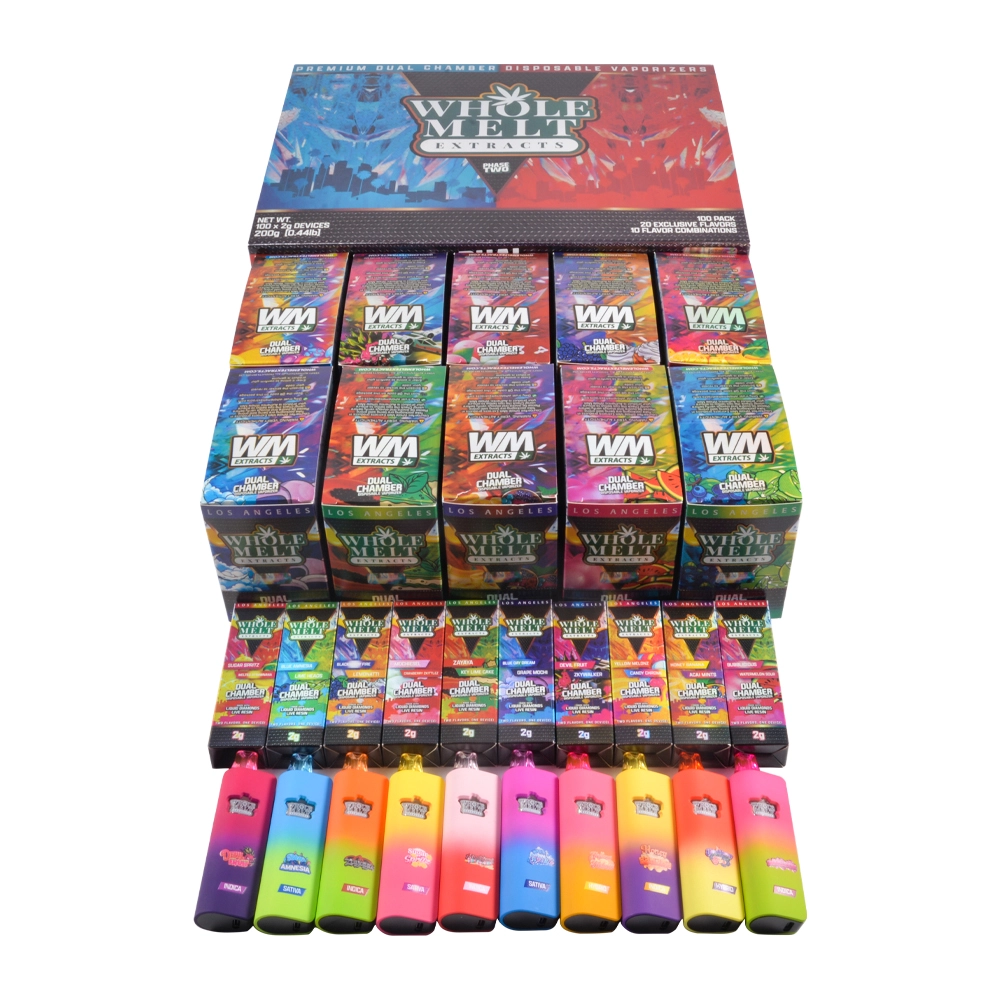
Whole Melt V7 Dual Tank 2g: A Practical Merchandising Playbook for Dual-Tank Devices
Dual-tank (dual-chamber) devices are not just a hardware trend—they are a merchandising format. When you stock a “two-in-one” device correctly, you reduce shelf complexity, create a premium step-up story, and increase basket size without doubling your SKU count. This guide explains how to merchandise the Whole Melt V7 dual-tank 2g format for retail clarity, faster turns, and fewer operational surprises.
Shelf story
“Two profiles in one device”
Operational advantage
Variety without SKU explosion
Premium laddering
Clear step-up from single-chamber
1) What you’re really selling: a dual-tank format (not “just another disposable”)
The V7 dual-tank concept is straightforward for shoppers: two separate reservoirs in one body, typically split as 1 ml + 1 ml for a total 2 ml. In modern designs, each chamber has its own flow path and switching logic so users can select A, B, or (in some versions) a blended mode. Your merchandising job is to make that concept instantly obvious at the shelf—without staff needing a long explanation.
Merchandising translation for customers
- Value: One device covers more preference scenarios (A/B choice) than a single-profile unit.
- Convenience: Less “decision friction” at the display—customers can choose both in one purchase.
- Premium cue: Dual tanks, a screen/indicator, and a more complex internal build justify premium placement.
2) Anchor your display with one “hero SKU” and keep the story consistent
Dual-tank devices sell best when your presentation is disciplined. Pick one hero listing to anchor imagery, spec callouts, and signage, then ladder adjacent options around it (colorways, screen/no-screen, activation type, etc.). For ExtractsVape, use these three internal resources as your core merchandising backbone:
- Whole Melt V7 dual tank 2g — use this as your primary “hero” PDP reference for key spec bullets and the two-in-one story.
- Whole Melt vape wholesale — use this as your brand assortment hub to build a clean step-up ladder across versions.
- dual chamber disposable — use this as your training/FAQ reference so staff and buyers have a single technical explainer.
3) Build a dual-tank planogram that increases turns (without clutter)
Dual-tank formats win when the shopper can understand the “why” in under 3 seconds. Use a simple planogram with one dominant block and one supporting block:
Recommended shelf structure
- Block A (hero): 60–70% of facings on the V7 dual-tank hero format.
- Block B (step-down or adjacent): 30–40% on a simpler single-chamber option or a price-fighter alternative.
- Do not mix too many “almost-the-same” dual-tank SKUs on the same hook. That creates paralysis, not choice.
Endcap vs. behind-the-counter: choose based on your shopper journey
- Behind-the-counter (high control): Best for stores that rely on staff explanation and want to reduce tampering/theft.
- Endcap / feature bay (high attention): Best when you have clean packaging, strong visual differentiation, and consistent pricing signage.
4) Use “spec merchandising” to reduce returns and complaints
In dual-tank devices, most avoidable issues come from mismatched expectations: charging behavior, switching behavior, or perceived inconsistency between chambers. You can reduce friction by merchandising the few specs that actually matter to retail outcomes.
| Callout (front-of-box or shelf talker) | Why it matters in retail | How to present it |
|---|---|---|
| Total capacity & split (2 ml total; dual tanks) | Clarifies the “two-in-one” value and reduces “is it really 2g?” disputes. | One line: “2 ml total • Dual tanks (A/B)” |
| Charging standard (USB-C) | Fewer compatibility questions at checkout; fewer charge-related returns. | Icon + “USB-C rechargeable” |
| Switching method (button/switch/screen indicator) | Prevents confusion about “how do I change chambers?” | Simple diagram or 2-step text: “Tap to switch A ↔ B” |
5) Retail-ready packaging: the 6 checks buyers expect in 2026
If you’re merchandising dual-tank devices at a premium tier, packaging discipline is non-negotiable. Buyers increasingly want proof of shipping safety, traceability, and scannability—especially for lithium-powered devices.
The 6 checks (what to request and what to display)
- UN 38.3 evidence: verify the battery’s transport testing status for air/ground logistics.
- Lithium test summary availability: ensure you can provide battery test summaries when requested by partners.
- Electrical safety approach: align hardware design/testing to recognized e-cig electrical safety standards where applicable.
- Drop/parcel robustness: use a parcel simulation procedure (commonly ISTA 3A) for packaging validation.
- Batch/lot traceability: printed lot codes that map to inbound QC records and supplier documentation.
- Barcode roadmap: prepare for 2D barcode adoption (Sunrise 2027) for better traceability and consumer engagement.
Tip: If you use QR/2D codes on master cartons, link them to a controlled document page (COA/QC checklist/shipping docs) rather than a generic marketing page. This keeps buyer audits smooth and reduces back-and-forth.
6) A 10-minute staff script that actually sells dual-tank
The best dual-tank merchandising is repeatable. Train staff to deliver the same 20-second explanation every time, then offer one guided choice.
20-second script
- Step 1 (concept): “This is a dual-tank device—two separate profiles in one unit.”
- Step 2 (benefit): “You get variety without carrying two devices.”
- Step 3 (how it works): “Use the switch/button to select A or B; the indicator shows what’s active.”
- Step 4 (guided choice): “Do you prefer a bright profile or a heavier one? We can pair the two in one.”
7) Common merchandising mistakes (and how to avoid them)
- Over-assorting dual-tank SKUs: too many similar options reduces conversion. Keep one hero and one alternative.
- Missing switching guidance: if the “how to switch” step isn’t visible, customers assume it’s complicated.
- Weak premium cues: premium pricing needs premium presentation—clean shelf talkers, consistent facings, and disciplined planogram blocks.
- No traceability story: dual-tank formats are premium; premium buyers expect lot discipline and shipping-safety documentation.
FAQ
Is dual-tank mainly a novelty, or does it improve sales?
In many retail environments, it improves sales when it reduces decision friction and creates a clear “step-up” from basic formats. The key is not the hardware alone, but the clarity of your shelf story and how tightly you control the assortment.
What’s the fastest way to test merchandising before scaling?
Run a 14-day A/B test: one store (or one bay) with a disciplined hero-block planogram and clear switching signage, and another with your current mixed presentation. Track unit turns per facing, attach rate to complementary accessories, and the share of staff-assisted conversions.
What documentation matters most for wholesale buyers shipping lithium devices?
Buyers commonly ask about UN 38.3 status, lithium battery test summaries, and shipping guidance alignment. For premium merchandising, having a clean “docs bundle” (even if shared as a controlled link) reduces friction and speeds reorders.
References (authoritative starting points)
- UN Manual of Tests and Criteria (UN 38.3) overview
- PHMSA: Lithium battery test summary requirement
- IATA lithium battery resources
- UL: UL 8139 vaping device electrical safety certification overview
- GS1 US: Sunrise 2027 (2D barcodes)
- ISTA procedures overview (including 3A)
Internal note for editors: if your exact V7 batch spec differs (battery mAh, activation type, indicator type), update the “spec merchandising” callouts to match your current datasheet. Consistency between shelf talkers, PDP bullets, and carton labeling is what reduces returns.
0 Comments