

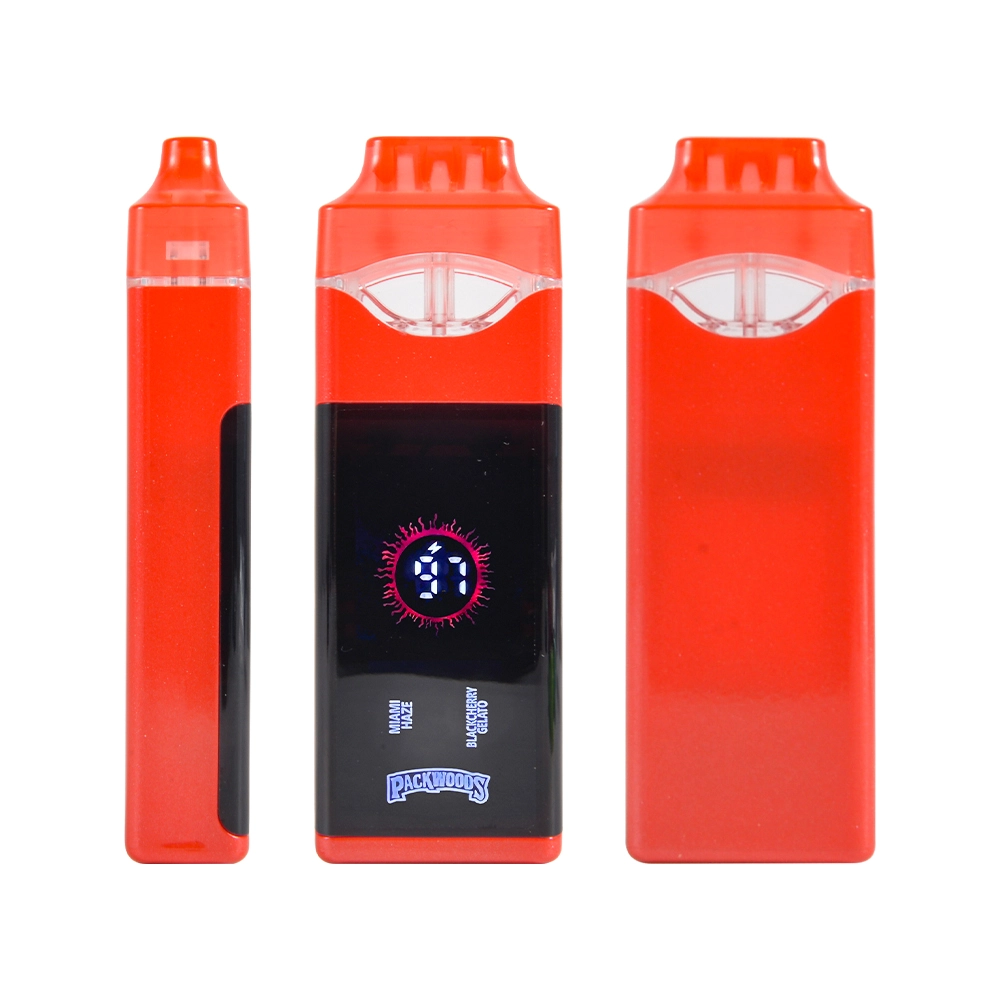
Buyer Guide 2g Devices Screen Models
Packwoods 2g With Screen: What’s Different vs Standard 2g Devices?
Screen-equipped 2g disposables are no longer a “nice-to-have.” For retailers and bulk buyers, they change how customers judge quality (battery anxiety, “is it empty?”, “is it clogged?”) and how you manage returns and support. Here’s what’s actually different—hardware, user experience, and wholesale-level QC.
Quick compare: screen vs standard 2g
A “standard” 2g disposable usually gives you a simple LED indicator (or no indicator at all). A screen model adds a display + a control board that tracks device state. That sounds cosmetic—until you see what it does to customer behavior and support tickets.
| What matters | Packwoods 2g with screen | Standard 2g disposable |
|---|---|---|
| Battery confidence | Battery % (or multi-step indicator) reduces “dead device” assumptions | Often a single light; customers guess when performance drops |
| “Is it empty?” support | Puff counter / usage display helps explain end-of-life vs clog | Users blame the device sooner; more “it stopped” reports |
| Consistency to the last draw | Better chance of regulated output and clearer low-battery behavior | Voltage sag can feel like “weak hits” before the user knows why |
| Feature set | Common: preheat, mode switching, lock/unlock, diagnostics | Common: draw-activate only, basic LED |
| Wholesale impact | More predictable troubleshooting; fewer “mystery” RMAs | Higher ambiguity: oil vs coil vs battery vs user error |
What the screen really changes
1) It turns “feel” problems into visible status
Most complaints about 2g disposables come down to uncertainty: “Is it charged?” “Is it clogged?” “Is it empty?” A screen answers at least one of those immediately. That reduces premature returns and helps staff handle customer questions without opening the device or guessing.
2) It enables smarter power behavior (not just a prettier UI)
A screen model typically implies a more capable control board. Even if the device is still draw-activated, the controller can do more: stabilize output, enforce low-voltage cutoffs, and run short preheat routines to help with thicker oils. The point isn’t “more features”— it’s more predictable performance across the battery curve.
3) It changes buying psychology in retail
Customers read a screen as “premium” and “tech-forward.” That can justify a higher price point, but it also raises expectations. If the UI is confusing, if battery % jumps, or if the screen drains power too quickly, the same feature becomes a liability. For B2B buyers, this is why screen QA is not optional.
If you’re evaluating a current listing, start from a known reference. Here’s a direct example product page: Packwoods 2g vape with screen.
Hardware differences you can measure
The easiest way to compare “screen vs standard” is to stop looking at marketing names and compare measurable specs: tank volume, intake geometry, coil resistance, battery capacity, and charging interface.
A) Display + controller stack
- Screen module quality: brightness, viewing angle, and durability under pocket heat.
- Firmware behavior: stable readings (battery/puff), reliable wake/sleep, no random resets.
- Parasitic drain: screen sleep current must be low enough that devices don’t self-discharge in inventory.
B) Charging interface (USB-C / Type-C) is more than convenience
Many screen models standardize on USB-C because customers expect it. For wholesalers, the bigger win is fewer “wrong cable” failures and fewer returns triggered by charging confusion. Still, USB-C doesn’t guarantee safe charging—your QC should verify port soldering, connector alignment, and cut-off behavior under over-current scenarios.
C) Intake geometry + oil flow (the hidden driver of clog complaints)
“Standard 2g” devices often prioritize airflow and easy pulls. Screen models—especially those marketed for thicker oils—may use different intake area strategies. On Extractsvape listings, you’ll see intake hole configurations like 2×1.8mm, 4×1.6mm, or 4×2.0mm depending on the specific Packwoods variant. The key takeaway: if your customer base uses higher-viscosity oils, intake area and wicking design matter as much as the coil material.
D) Coil resistance and real-world draw feel
Many Packwoods-style 2g devices list around 1.4Ω resistance. Resistance alone doesn’t guarantee flavor or cloud quality, but it’s a useful baseline for comparing batches. If resistance drift is high lot-to-lot, you’ll see inconsistent heat, “weak hits,” or burnt notes—especially near low battery.
E) Battery capacity and end-of-life behavior
You’ll commonly see batteries in the low-300mAh range on 2g disposables. Screen models can feel “better” if the control board manages voltage sag more gracefully. But screens also add a small power load—so the device must be engineered to maintain performance without draining itself in storage.
QC + returns: why screens can reduce “mystery failures”
Screen models reduce ambiguity—if the UI is trustworthy
A standard disposable that “stops hitting” triggers a long list of guesses: battery dead, clog, coil flooded, oil too thick, user draw technique, or a genuine defect. With a screen, you can eliminate at least one major unknown (battery state), and sometimes get more signals (puff count, mode status). That can cut RMAs that are really “end of life” or “needs a short preheat.”
But screen models create new QC failure modes
- Dead pixels / dim screens: often shipping or assembly stress.
- Button/UI failures: stuck buttons, UI that won’t wake, accidental activation in pockets.
- Firmware bugs: puff counter resets, battery % jumps, false “low battery.”
- Electrostatic sensitivity: controller resets after dry winter handling if protection is weak.
Safety and compliance signals you should request in B2B
If you ship rechargeable devices internationally, battery documentation and safe transport practices matter. For bulk procurement, ask your supplier for battery safety testing evidence and lithium transport documentation (e.g., UN 38.3 test summary availability, and relevant battery safety standards used by upstream cell vendors). This isn’t just bureaucracy—it reduces shipment delays and supports a cleaner compliance story for your customers.
Wholesale checklist (sample-to-bulk)
Step 1: Confirm the exact variant (screen single-tank vs screen dual-tank vs standard)
- Request photos/video of the screen UI in operation (battery indicator, puff counter if present, mode/preheat if present).
- Confirm tank style: single reservoir vs dual tank / dual chamber.
- Verify charging interface and cable fit (USB-C alignment, stable charging, no wobble).
Step 2: Run 5 fast QC gates on samples
- Screen accuracy check: does battery % drop smoothly, and does it correlate with actual run time?
- Airflow + clog stress: chain draws + rest cycles; watch for gurgle, spitback, or hard pulls.
- Resistance audit: measure a small sample set; reject lots with wide drift.
- Charge protection behavior: verify cut-off and heat under charging; no overheating or swelling.
- Drop + pocket test: short drop test to see if the screen, port, or internal connections fail.
Step 3: Set clear acceptance criteria for bulk
- Define allowable screen defect rate (dead pixels, brightness variance, UI failure).
- Define airflow tolerance and leak tolerance (especially for high-viscosity oils).
- Define what counts as “normal end-of-life” vs “defect” for customer support.
If you’re stocking multiple 2g lines and want to standardize merchandising, you can also position these as part of your broader 2g disposable thc vape selection—then highlight “with screen” as the upsell feature.
FAQ
Does a screen make a 2g device hit better?
Not automatically. The screen itself doesn’t change the coil. The improvement usually comes from the control board and power behavior that often accompanies screen models (more predictable low-battery behavior, optional preheat, clearer status).
Will the screen drain the battery faster?
It can—slightly. A well-designed device will put the screen into a low-power sleep state and wake only on draw/button events. Poor designs drain during storage, which is why inventory aging tests matter for wholesalers.
Is dual-tank “with screen” the same as standard 2g?
No. Dual-tank designs add another set of seals, pathways, and switching behavior—more moving parts, more QC checkpoints, but also higher perceived value at retail when executed well.
What should I ask a supplier before placing a bulk order?
Ask for: a short UI demo video, battery/charging protections, resistance targets with tolerance, intake/airflow spec, packaging spec, and any lithium battery transport documentation your shipping lane may require.


0 Comments