

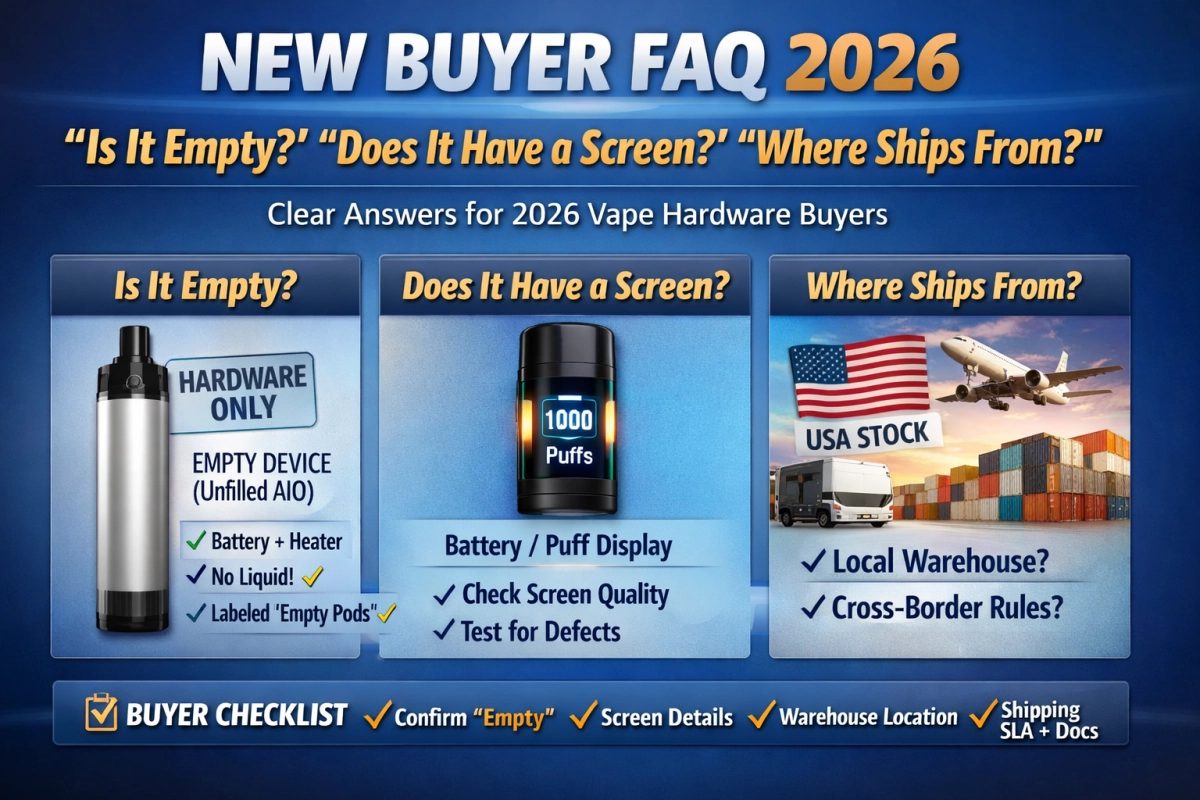
New Buyer FAQ (2026): “Is It Empty?” “Does It Have a Screen?” “Where Ships From?”
If you’re new to wholesale vape hardware, these three questions decide whether you’re buying the right SKU, avoiding returns, and setting correct delivery expectations. This FAQ is written for buyers who want clear, repeatable answers—without guesswork.
Quick Answers (save this)
| Buyer question | Fast answer | What to verify before paying |
|---|---|---|
| Is it empty? | “Empty” means the device ships unfilled (hardware only), but it’s still a complete AIO platform (battery + heater + reservoir body). | Look for “Empty Pod/Empty Pods” wording, capacity spec (ml/g), and “hardware-only” language in the listing or seller confirmation. |
| Does it have a screen? | “Screen” typically means a puff/battery indicator (sometimes voltage). It’s a UX feature—not automatically a quality guarantee. | Confirm what the screen displays, how it’s triggered, and your QC acceptance criteria for dead pixels/segments. |
| Where ships from? | The fastest outcomes come from local stock (e.g., US warehouse inventory). Cross-border shipments depend on carrier limits, customs, and battery rules. | Ask: warehouse location, carrier, dispatch time, tracking SLA, and any destination exclusions before checkout. |
1) “Is it empty?” — what “empty” actually means in 2026
Definition buyers should use
In wholesale catalogs, “empty disposable” is shorthand for a pre-assembled all-in-one device that ships unfilled. It arrives as a complete platform: battery, protection circuit, heater, reservoir body, mouthpiece/seals, and draw activation (sometimes USB-C and a screen).
Practical meaning: you’re buying the device platform—not the contents. Your operational risk (leaks, DOA units, charging failures) usually comes from hardware consistency, not the label on the box.
How to confirm “empty” in 30 seconds
- Read the listing language: “Empty Pod/Empty Pods” is a strong signal.
- Check capacity specs: listings often show tank volume in ml and/or “2g/3g” as a platform capacity.
- Ask one plain question: “Is this shipped unfilled (hardware-only)?”
- Get it in writing: save the confirmation for dispute/returns if needed.
Browse the “empty” catalog
If you want to filter to hardware-only SKUs quickly, start here: empty disposable vapes bulk . Use it as your “baseline collection” when you’re comparing features like charging type, airflow, and optional screens.
What “empty” does not mean
- Not “missing parts”: an empty device is still a complete unit with a battery and heating system.
- Not “unregulated shipping”: battery-powered devices still fall under transport rules and carrier restrictions.
- Not “one-size-fits-all”: your return rate depends on coil design, seals, assembly, and QC—not the word “empty.”
Tip: if you’re a repeat buyer, ask for a consistent SKU code, revision notes, and a simple change-control promise (no silent swaps).
2) “Does it have a screen?” — what screens do (and don’t) tell you
What most “screen” devices display
- Battery indicator (bars or percentage)
- Puff counter (often resets at a threshold or after charge)
- Voltage / mode (on some models)
Screens mainly reduce “support friction” (buyers can see battery status), but they introduce new QC failure modes (dead segments, scratched lenses, inconsistent activation).
Screen ≠ quality (use this decision rule)
Choose a screen when:
- You sell to customers who demand “battery/puff visibility.”
- Your brand is premium-positioned and packaging needs the “tech” cue.
- You have inbound QC that can catch display defects early.
Skip the screen when:
- You prioritize lowest defect rate and simplest user flow.
- Rough handling is common in your channel (screens scratch).
- Your returns are driven by leaks/clogs—fix seals/airflow first.
Shop screen models (internal link)
To compare screen-enabled hardware in one place, use this collection: disposable vape with screen . When you shortlist SKUs, ask what the screen shows and whether it’s tested at the factory (and how).
A simple screen QC acceptance checklist (buyer-friendly)
- Activation: screen turns on reliably via draw / button (whichever the model uses).
- Readability: digits/icons are legible under normal lighting.
- Defects: no dead segments, flicker, or misaligned lens.
- Scratch check: wipe + light inspection on lens/window area.
- Post-charge behavior: display still works after a short charge cycle.
3) “Where ships from?” — how to predict real delivery outcomes
Two shipping realities in 2026
- Local stock = predictable delivery. If inventory is already in your country/region, you avoid most cross-border delays.
- Cross-border = rules + customs + carrier constraints. Battery-powered products can be restricted by carriers or require specific packaging/marking—so timelines vary.
If you’re shipping to the U.S.
For the fastest outcomes, prioritize items labeled as U.S. warehouse inventory: USA stock vape. That collection is designed for buyers who want “ships-from-USA” availability and quicker final-mile delivery.
Buyer move: ask which warehouse is fulfilling your order (many sellers operate CA/NJ or similar hubs), then confirm carrier and cutoff time.
If you’re shipping internationally
- Expect variability: customs clearance and weather can extend ETA.
- Ask about carrier restrictions: some routes reject “e-cigarette” categories or impose special handling rules.
- Plan for compliance documents: battery transport documentation may be requested by carriers or forwarders.
If your order contains lithium batteries (most AIO disposables do), shipment safety rules matter. If a seller can’t provide battery transport documentation when asked, treat that as a sourcing risk—not a “nice-to-have.”
A 7-question buyer checklist
- Confirm “empty”: “Is this shipped unfilled (hardware-only)?”
- Confirm screen behavior: “What does the screen display (battery/puffs/voltage)?”
- Confirm ship-from location: “Which warehouse/country will fulfill my order?”
- Confirm dispatch SLA: “How many business days to ship after payment?”
- Confirm carrier + tracking: “Which carrier and when do I receive tracking?”
- Confirm battery documentation availability: “Can you provide lithium battery test summary / transport docs if requested?”
- Confirm returns/RMA rules: “What qualifies as DOA and what’s the claim window?”
If a supplier answers these clearly, you’re already ahead of most new buyers.
Mini-FAQ: follow-up questions new buyers ask next
“Empty” listings still mention “2g/3g”—why?
In many catalogs, “2g/3g” describes the platform capacity (reservoir size class), even when the unit ships unfilled. Treat it as a device size indicator unless the seller explicitly states contents.
Does a screen increase defect risk?
It can. Screens add components that can fail (display segments, lens scratches, activation logic). If you choose screen models, make screen checks part of your inbound QC so you catch issues before resale.
Why do ETAs change after I place an order?
Common causes: warehouse allocation changes, carrier route limits, customs holds, and lithium-battery handling requirements. The fix is to verify ship-from location and carrier before payment, then track against the seller’s dispatch SLA.
What should I do if my destination has carrier exclusions?
Ask for an alternate route (different carrier or forwarder), and confirm fees and delivery promise in writing. If a seller can’t ship to your region reliably, treat it as a supply-chain mismatch and source a closer stock option.
One-sentence takeaway
In 2026, the best buyers win by confirming “empty,” choosing screen features intentionally, and verifying ship-from inventory before paying.
Compliance note: This article is informational and focuses on hardware sourcing and logistics. Always follow local laws and carrier requirements for battery-powered devices.

0 Comments