

Muha Meds 2g Drops: What Repeat Buyers Expect in 2025–2026
Updated for 2025 planning and 2026 continuity: a B2B-focused checklist for repeat orders, fewer surprises, and smoother sell-through.
What a “2g drop” means to repeat buyers now
In 2025, “2g drops” stopped being only about what’s new. For repeat buyers, a drop is a predictable restock event that should fit existing merchandising, fulfillment, and customer-support workflows. The winning suppliers are the ones who treat each drop like a controlled release: consistent specs, clear packaging versions, stable defect rates, and easy-to-verify authenticity signals.
That’s why many wholesale teams now judge a drop with two questions: (1) Will this batch behave like the last batch? and (2) If it doesn’t, will we find out before it hits shelves?
If you’re sourcing Muha-style 2g devices as a repeat buyer, start by keeping your category paths tight. For browsing and restock planning, use Muha Meds vape wholesale to compare versions and confirm availability, then benchmark comparable options across the broader 2g disposable wholesale landscape, and finally cross-check shell-only choices in empty disposable vapes bulk when your workflow requires device-only consistency.
Expectation #1: spec stability (so reorders don’t break your SOPs)
Repeat buyers don’t want “mystery revisions.” In 2025–2026, the expectation is a stable spec sheet across drops, plus explicit disclosure when anything changes (even “small” changes like inlet geometry, coil resistance target, or charging components).
A practical baseline spec table (what teams document per drop)
For 2g-class devices, many buyers standardize around a baseline that’s easy to train, QC, and support. A typical baseline your team can document per drop looks like this:
| Spec item | What repeat buyers want | Why it matters |
|---|---|---|
| Tank / fill volume class | 2.0 ml class stated clearly | Aligns labeling, run-rate forecasts, and “how long it lasts” expectations |
| Battery capacity class | Published capacity band and protection behavior | Lower DOA + fewer “won’t charge” tickets and fewer returns |
| Charging interface | USB-C with consistent port placement | Reduces cable/charger confusion and improves customer satisfaction |
| Inlet geometry | Declared inlet pattern (e.g., dual inlets) and tolerance discipline | Prevents viscosity mismatch issues and leak-rate variance |
| Resistance target | Stable resistance window per SKU | Controls heat profile, draw feel, and consistency across batches |
| Packaging format | Boxes and version labeling (edition names, run IDs) | Prevents “same listing, different box” disputes |
The key is not the exact numbers—it’s the repeatability. Your best drops are the ones where a reorder can be inspected using the same AQL plan, the same work instructions, and the same receiving checklist.
Expectation #2: screen-ready UX that reduces support tickets
Screens and indicators are no longer “nice to have.” In 2025–2026, repeat buyers increasingly treat a display as a support cost reducer—because it answers basic questions before the customer contacts you. When a drop includes a screen, buyers expect:
- Clear state-of-charge feedback (so customers don’t assume “dead” when it’s just low)
- Consistent charge behavior (stable port fit, stable cable compatibility)
- Predictable indicator logic (no random icons, no confusing blink patterns)
- Lower variance between units (screen brightness, responsiveness, and button feel if present)
What buyers document for screen drops
To make repeat orders safer, buyers increasingly ask sellers to document display behavior as if it’s a mini “UI spec”: what the display shows at low battery, what it shows while charging, and what “fault” signals look like. This reduces disputes because everyone is aligned on what “normal” looks like.
Expectation #3: authenticity + traceability you can explain in 30 seconds
Repeat buyers don’t only care that a product is authentic—they care that their staff can verify and explain authenticity quickly at the receiving dock, in the warehouse, and at retail. In 2025–2026, the expectation is a layered approach:
- Visible packaging signals (clear edition labeling, print consistency, tamper evidence)
- Trackable identifiers (case/lot style identifiers that map to inbound receiving logs)
- Documentable evaluation method (so authenticity checks aren’t “vibes-based”)
If you’re building an authenticity workflow, anchor it to recognized frameworks: use performance-style evaluation criteria for authentication features, and implement traceability practices that can scale across your network (warehouse, 3PL, retail, customer support).
What “good” looks like in practice
- Every case maps to a PO line, a receiving timestamp, and a responsible handler (chain-of-custody discipline).
- Every edition name corresponds to a versioned spec + packaging reference image (so “same SKU” doesn’t hide revisions).
- Returns can be traced back to a lot/run to spot patterns early (screen failures, leak-rate spikes, charging-port variance, etc.).
Expectation #4: QC gates with clear acceptance bands
The biggest difference between one-off buyers and repeat buyers is this: repeat buyers want boring, consistent QC. In 2025–2026, the expectation is a documented QC path from samples to bulk—with acceptance bands that match your risk tolerance.
Recommended QC gates for 2g drops
- Pre-production sample set: confirm spec sheet, packaging version, and cosmetic baseline.
- Golden sample lock: freeze reference photos + key measurements for the run.
- In-process checks: focus on leak paths, port fit, screen function, and button behavior (if present).
- Pre-ship AQL inspection: attribute sampling for critical / major / minor defects.
- Inbound receiving audit: quick verification on arrival to detect shipping damage or lot drift.
Example acceptance bands (you can adapt to your SOP)
- Critical defects: safety hazards, charging faults, severe leakage, non-functional screen → target: zero acceptance.
- Major defects: intermittent function, loose port fit, significant cosmetic mismatch → low tolerance.
- Minor defects: small cosmetic variance not visible at shelf distance → defined tolerance.
The point is to keep your enforcement consistent across drops. If your acceptance bands change every reorder, suppliers can’t stabilize processes—and your defect rate stays noisy.
Expectation #5: pack-out and logistics that survive parcel handling
In 2025–2026, repeat buyers increasingly treat packaging as part of product quality. A “great device” that arrives scuffed, crushed, or misboxed is a returns multiplier. Strong drops include:
- Consistent case pack (so 3PL counts are correct and shrink is easier to detect)
- Protective internal packing (so screens/ports don’t get stressed in transit)
- Drop-tested packaging approach aligned with parcel handling realities
Why repeat buyers care
Drops are time-sensitive. When packaging fails, you lose the window: customer complaints spike, replacements consume inventory, and your “new drop” becomes a support backlog. The best suppliers treat packaging as a controlled system, not an afterthought.
Expectation #6: RMA/CAPA terms that protect repeat margins
Repeat buyers don’t just ask “can you replace defects?” They ask “can we prevent repeats?” That’s why 2025–2026 expectations include a light-but-real corrective action loop:
- RMA rules: what evidence is needed, what timeframe applies, and what’s credited vs replaced
- Batch accountability: returns tied to lot/run identifiers
- Causal categories: leak path, charging, screen, cosmetics, packaging damage
- Preventive action: what changes before the next drop ships
The ROI is simple: when you can name the failure mode and tie it to a specific run, you stop paying “random defect tax” every reorder.
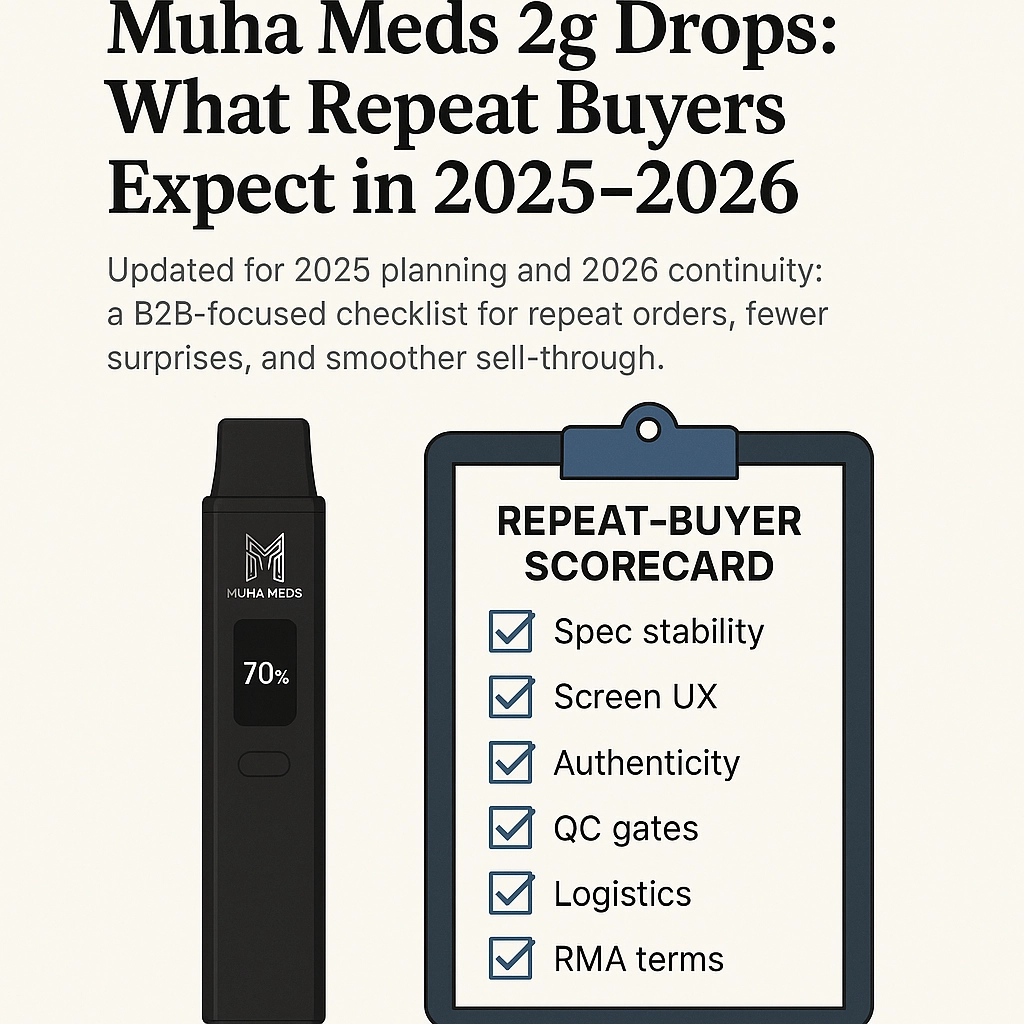
A repeat-buyer scorecard for 2025–2026 drops
Use this scorecard to evaluate any Muha-style 2g drop before you scale a reorder:
- Spec stability: same spec sheet? changes disclosed? versioned edition naming?
- QC evidence: sampling plan + results summary + inbound audit pass rate?
- Authenticity workflow: quick-check method your staff can execute in minutes?
- Packaging survivability: fewer crushed corners, fewer scuffs, fewer “box swap” disputes?
- Support friction: fewer “won’t charge,” fewer “dead on arrival,” fewer “screen weird” tickets?
- RMA/CAPA discipline: lot-based accountability and clear remedy paths?
Quick checklist to use before every PO
Print this. Use it. Enforce it the same way every drop.
- Confirm edition/version naming and request reference packaging images for this drop.
- Lock the spec sheet and treat any change (even minor) as a new version.
- Require a pre-ship inspection summary aligned to your defect categories.
- Define your inbound receiving audit: carton condition, random unit function check, and packaging consistency.
- Agree in writing on RMA evidence rules, time windows, and remedies for each defect class.
- Track outcomes by lot/run so the next reorder gets smarter—not riskier.
In 2025–2026, the best “Muha Meds 2g drop” isn’t the flashiest one—it’s the one that repeats cleanly. When the drop is predictable, your reorders scale, your support load shrinks, and your margins stop leaking.
0 Comments