

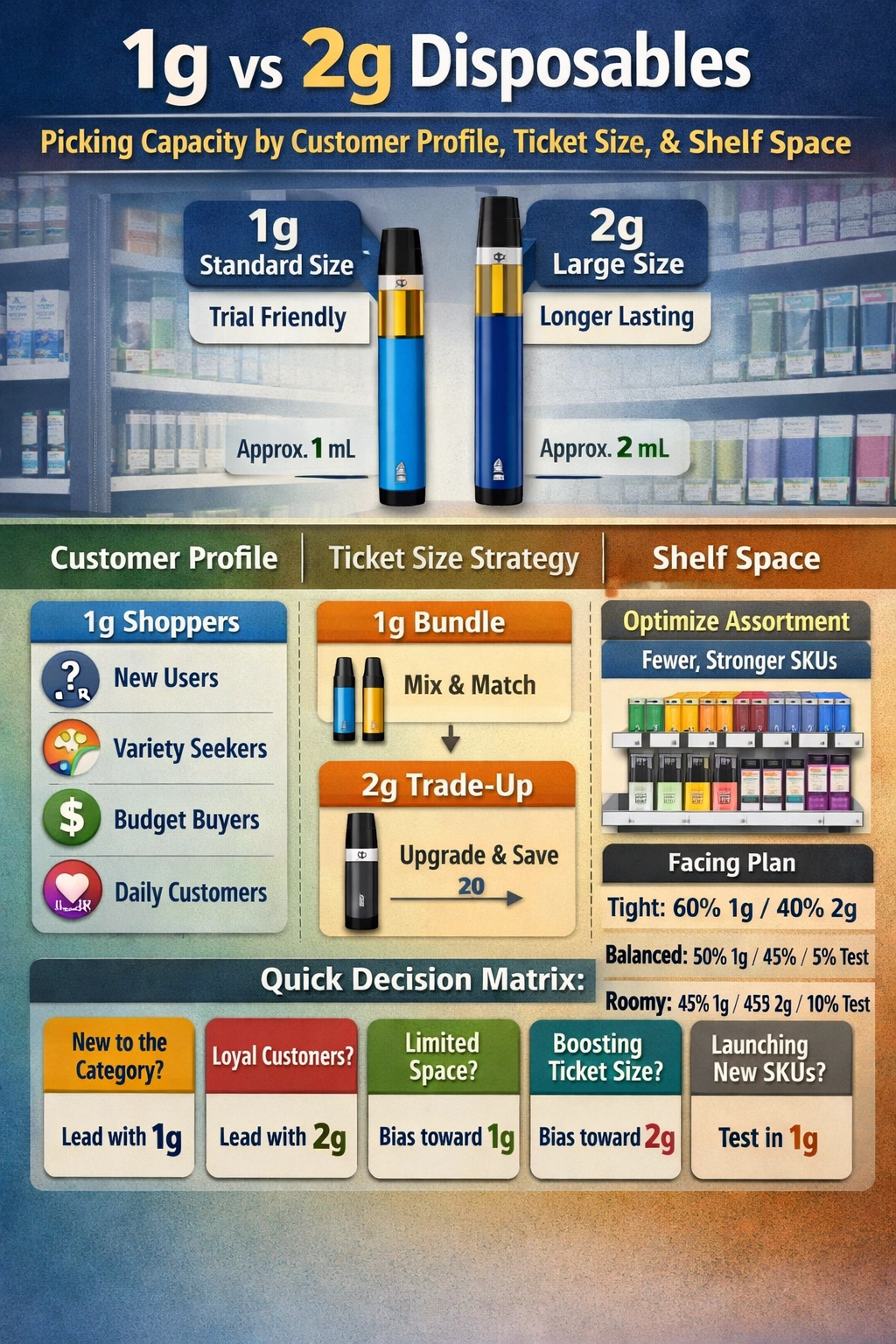
1g vs 2g Disposables: Picking Capacity by Customer Profile, Ticket Size, and Shelf Space
Choosing between 1g and 2g disposables isn’t just a “bigger is better” decision. Capacity changes how shoppers buy, how quickly inventory turns, and how many winning SKUs you can fit in the same display footprint. This guide helps retailers and brand operators match capacity to customer profiles, average ticket goals, and shelf constraints—so your assortment feels intentional, not random.
What 1g and 2g actually mean (and why it’s approximate)
In most retail conversations, “1g” and “2g” describe the intended fill amount for the disposable platform. Shoppers often treat it like “about 1 mL vs about 2 mL,” but oil density varies by formulation and temperature, so it’s best to communicate capacity as a useful approximation, not a lab-grade conversion.
A practical way to explain this without overcomplicating it: some regulated-market educational resources use a conversion factor (0.93) when translating label units (mg/g) into per-mL estimates—highlighting that grams and mL are close, but not identical for oils. (This is exactly why “lasts twice as long” isn’t a promise; usage behavior and formulation matter.)
- 1g: best positioned as “standard/trial-friendly” capacity
- 2g: best positioned as “value/longer-run” capacity
Customer profiles: who should see 1g vs 2g first
When 1g usually wins
1g formats tend to convert well when the shopper is optimizing for variety, low commitment, or lower upfront spend. You’ll typically see 1g perform strongly with:
- New-to-category shoppers who want a safer “first buy” before committing to a larger size
- Variety seekers who rotate strains/flavors frequently
- Budget-sensitive shoppers who prefer a lower price point per unit
- Occasional users who don’t want product sitting around as long
Merchandising tip: if you have limited display space, 1g can support more “choice density” (more distinct SKUs) without overloading any one SKU’s on-hand inventory.
When 2g usually wins
2g formats tend to convert well when the shopper is optimizing for value perception, fewer repurchases, or longer use between trips. You’ll typically see 2g perform strongly with:
- Daily or high-frequency shoppers who prefer fewer repeat purchases
- Value shoppers who respond to “longer-lasting” positioning
- Loyalists who already know what they like and want a bigger format
- Destination shoppers (longer travel, fewer store visits) in markets where that applies
Merchandising tip: 2g is often the cleanest path to a higher unit price point—especially when paired with premium positioning (e.g., “feature-rich,” “screen,” “dual chamber,” or other platform differentiators).
Ticket size strategy: bundle vs trade-up
Capacity can lift ticket size in two different ways. The best choice depends on what your customers do naturally.
Strategy A: 1g for “bundle behavior”
If your customers like mixing options, 1g can raise average ticket by encouraging multi-item baskets (two different 1g choices instead of one larger option). This works especially well when your shelf talkers and menus make pairing easy (e.g., “day + night,” “two moods,” “two flavors”).
Strategy B: 2g for “trade-up behavior”
If your customers prefer one dependable pick, 2g can raise average ticket via a straightforward trade-up: “same style, more capacity.” This works best when the trade-up is obvious at the shelf: consistent branding, clear capacity callout, and a simple value story.
Shelf space: how to win with fewer, stronger facings
Shelf space is finite, and crowded assortments can reduce visibility and complicate the decision. Industry shelf/assortment practice increasingly favors space-aware assortments—fewer low-performing SKUs, more space per winner, and clearer navigation. NIQ (NielsenIQ) explicitly frames assortment optimization as a way to create more shelf space per item and improve category organization.
A simple facing plan (works for most small-to-mid displays)
Start with a “core + premium + experiment” structure. You can implement this on a pegboard, a countertop tray, or a locked display:
| Shelf situation | Recommended mix | Why it works |
|---|---|---|
| Very tight (few facings) | 60% 1g / 40% 2g | Maximizes choice while keeping a value ladder visible |
| Balanced (typical small shop) | 50% 1g / 45% 2g / 5% test | Supports both bundle and trade-up behavior |
| Roomy (strong traffic + broad tastes) | 45% 1g / 45% 2g / 10% test | Lets you rotate seasonal or novelty formats without bloating the core |
What to cut first (so shelf space actually improves)
- SKUs with low velocity and weak differentiation (similar flavor/style, no clear role)
- Redundant mid-sellers that cannibalize your top performer
- “Nice to have” variants that create shopper confusion at the point of decision
This is the heart of shelf productivity: fewer choices that sell more reliably often look “smaller,” but perform bigger.
A quick decision matrix you can use today
Use these questions to decide what to lead with in-store (or on your menu) without guessing:
- Are customers trying new things often? Lead with 1g, keep 2g as the value trade-up.
- Are customers loyal to a few favorites? Lead with 2g, keep 1g as the entry option.
- Is your display space tight? Bias toward 1g to increase SKU variety without overstocking.
- Is ticket size the main KPI this month? Bias toward 2g for clearer trade-up economics.
- Are you launching new SKUs? Test in 1g first to reduce risk, then scale winners into 2g.
If you want to browse by capacity on Extractsvape, start here: 1g disposable vape bulk, 2g disposable vape pen, and the broader assortment of wholesale disposable vapes.
How to test your mix in 30 days
The fastest way to get the “right” 1g/2g split is to test a tight plan and iterate. Run a 30-day loop:
- Week 1: set a clean baseline mix (e.g., 50/45/5) and lock facings
- Week 2: swap only the bottom 10–15% performers (avoid changing everything)
- Week 3: promote the top 2–3 movers with an extra facing (visibility matters)
- Week 4: decide: expand winners, discontinue chronic laggards, and reset par levels
Metrics that actually tell you what’s happening
- Units per facing per week (shelf productivity)
- Sell-through time (inventory risk)
- Basket composition (bundle vs trade-up behavior)
- Repeat rate by capacity (who comes back for 1g vs 2g)
Practical compliance note
Always follow your local rules for age gating, merchandising, packaging, and product claims. Capacity decisions should support a clear, responsible shelf experience: easy-to-understand options, minimal confusion, and consistent information at the point of sale.
0 Comments